
Notes
This is a place for thinking out loud, reflecting, and sharing ideas. Notes are a window into my process, thoughts, inspiration, and experiments. Explore visual gallery.
This is a place for thinking out loud, reflecting, and sharing ideas. Notes are a window into my process, thoughts, inspiration, and experiments. Explore visual gallery.
A teammate once gave me feedback that when I say "to [insert name]'s point" in group settings, they feel validated. So, when I don't say this, they worry that I'm not on board with their approach or idea.
I had never thought about my use of this phrase or how it might impact others. Our words carry weight, sometimes more than we realize.
We'll likely say something today that we'll disagree with years from now and may have never considered years ago.
I used to worry about this when I first started writing publicly. I thought that if I contradicted myself somewhere along the line, people might call me a hypocrite.
I no longer let myself get hung up on this train of thought. If we are hungry for knowledge and information, our beliefs are bound to change. From that perspective, contradiction can actually be a symbol of growth.
Sharing our ideas and engaging others in them is one way to put our growth in hyperdrive. It not only requires us to articulate our thoughts, but it invites feedback, helping us see the world from a new vantage point.
It's better to have an idea, shape it, share it, learn from it, and evolve it than to never let it out of your mind.
Starting to see that our ability to make progress and build momentum has less to do with time management or prioritization and more to do with how connected we feel to our vision and how courageous we feel to take the first step, no matter how imperfect it may be.
If you walked one mile per day for one year, you could walk the entire length of Pennsylvania (~170 miles) and back. Then, spend the last 25 days or so walking a marathon (26.2 miles).
Just another way of saying that small steps add up, but taking no steps gets you nowhere.
What good is a lamp without power?
It doesn't matter how bright it can shine if it can't shine.
Like a lamp, we all need an outlet for power, an outlet to light us up.
An outlet to experiment.
An outlet to share ideas.
An outlet to learn from others.
An outlet to express ourselves.
An outlet to think.
Unlike a lamp, our outlets can come in many forms.
A journal.
A group of peers.
A song.
A canvas.
A podium.
We'll never know just how bright we can shine if we can't shine.
We all need a power outlet.
I need a vacation.
I used to say this if I was feeling inundated with to-dos and responsibilities. It seemed like escaping for a while would give me the relief I needed.
The thing is that even after weeks away, it only took a moment for all of the weight to return. Commitments are still commitments. Issues are still issues. So, what was the point? Temporary peace?
These days, I do my best to stop saying I need a vacation and start asking, why? What needs to change? I'd rather live a life that I don't need to escape every now and then.
Vacation should be a time for re's. Relax, reset, reimagine, rejuvenate. Not running.
Today's newsletter is about the power of letting go as a manager and trusting the team to succeed with your guidance and support. As I made my final newsletter edits and prepared for the day, I learned about a hiccup on a recent project.
Every bone in my body was ready to put all of my other priorities aside to jump in and try to make it right. Luckily, with the topic of my newsletter top of mind, I paused and thought instead. How could I help the team get this on track without doing it myself?
By the end of the day, we had a plan in place. One that didn't involve me getting in the weeds. I lost some time in the day, but I know the time spent now will pay off in spades down the line.
"Through thick or thin, in spite of the hundreds of things calling for your attention every day, never forget what you’re ultimately here to do: help your team achieve great outcomes." (Julie Zhuo, The Making of a Manager)
It's one thing to write about and reflect on concepts. It's another to apply them. Today was a welcome reminder to take my own advice. Also, to never stop revisiting, questioning, and evolving old ideas.
I loved this Gretchen Rubin quote featured in James Clear's newsletter this week:
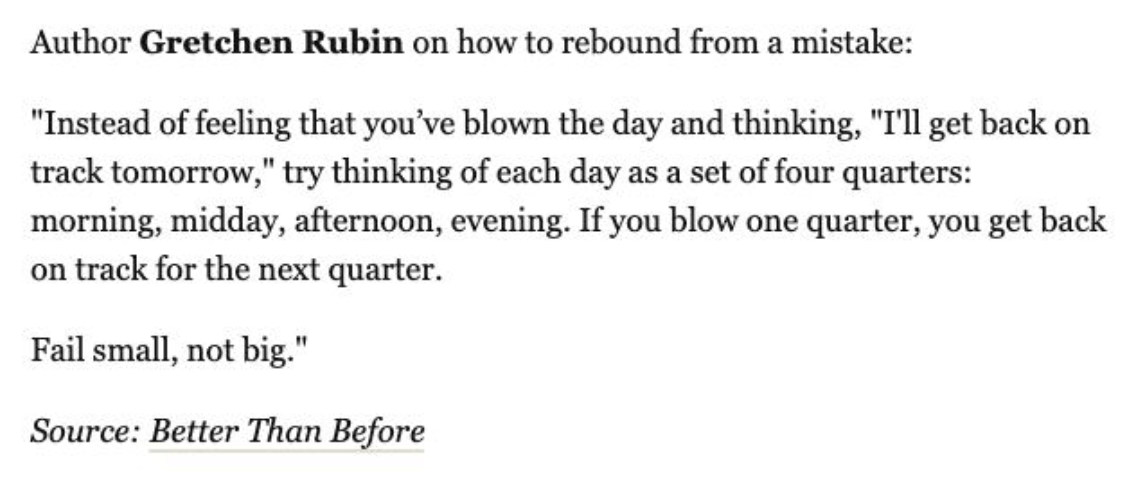
There's so much power in this simple shift in mindset. I can think of one too many times when something didn't go as planned, and I let it bring me down, shaping my mood for the rest of the day. A distraught client, a miscommunication between employees, you know the drill. The thing is that when I let these experiences have a negative impact, it makes it harder for me to show up fully and turn them around.
I've learned to remind myself that nothing is the end of the world, but I love the idea of replacing "I'm having a bad day" with "I had a bad quarter" and taking steps to make the next quarter incredible.
I don't get much natural light in my current apartment, so when we first started working from home last year, I joked that I was working in a dungeon. It was funny, but I didn't love looking like I was in the dark all the time, especially when interacting with clients or new acquaintances.
I eventually found a lighting kit that brightened things up, but the clarity was still awful. Side note: I'm still amazed that even the latest Macbook Pro camera looks like we're in the early 2000s.
Anyway, everything changed when fellow Barrel partner Peter told me about Camo Studio via a mutual friend, Hum. Camo Studio allows you to use your iPhone as a camera (I have an iPhone 11 Pro Max), and the results are insane.
Here's a before and after (with the same lighting):
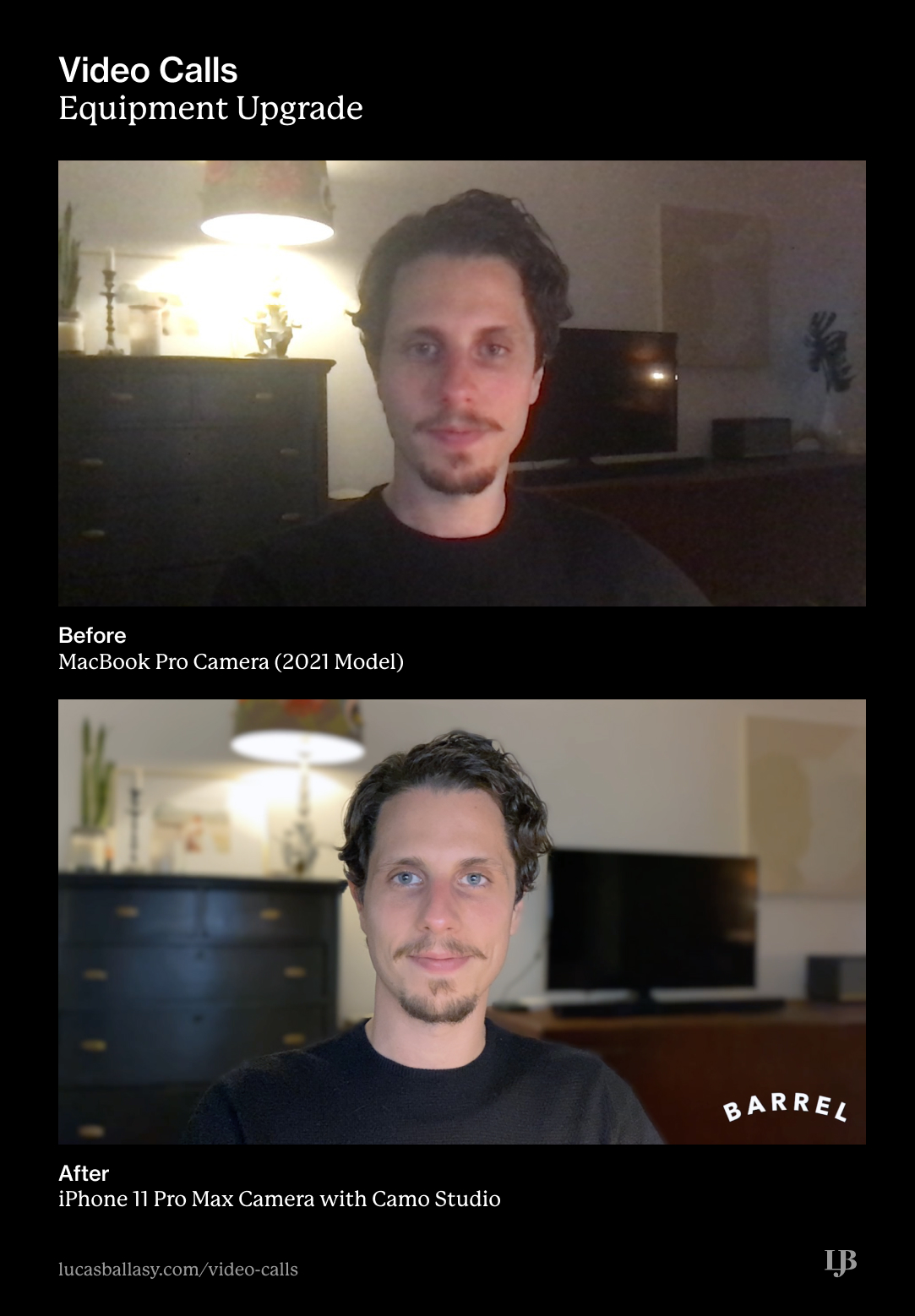
The comments after I started using Camo Studio ranged from "Whoa, your eyes are blue!?" to "Wait, why does it look like you're a YouTube influencer?" That was months ago now, but the comments haven't stopped.
To make it easier to use my phone, I revisited my setup. Here's a look at my desktop:
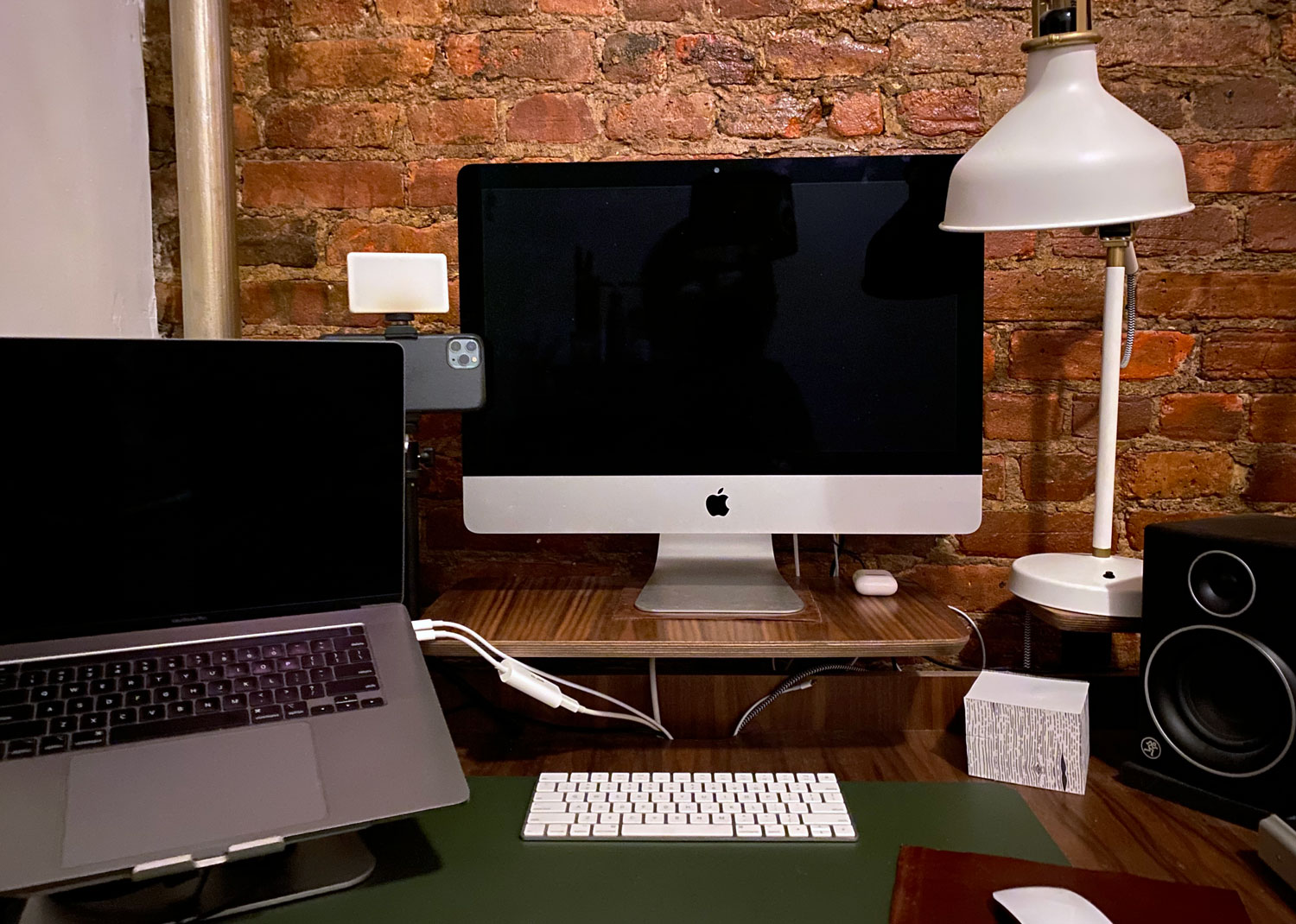
The more I meet new people (or catch up with friends and peers), the more I get asked about my setup, so I figured I'd list it here for easy reference. I figure that for every person who asks me, there's at least one other person out there looking to upgrade their video call appearance.
Below is a breakdown:
Happy video calls!
Dayton is an Art Director at a 25-person marketing agency. He's only a year in, but he loves his job. Great team, great clients. He's happy.
One day he happens to see a Slack message from a co-worker, Jessica, at 7:52 pm. He doesn't have much going on, so he responds. A few minutes later, Jessica writes back.
Now it's 9:43 pm... 11:57 pm... Dayton realizes that he hasn't eaten dinner yet, let alone shower, read... Midnight comes and goes. 12:31 am...
Now it's 1:27 am, six hours since his response to Jessica. "Okay, I agree. Any other ideas on how we could push it further?"
Dayton eats a bowl of corn flakes before his head hits the pillow. He grabs some mouthwash and thinks, I can brush my teeth tomorrow.
The sun comes up, and he is exhausted, staying in bed as long as possible, squeezing every bit of sleep out of the morning. He can still taste remnants of what used to be his favorite cereal. He brushes his teeth but skips the rest of his everyday morning ritual before jumping on Zoom for his 10 am.
By lunchtime, Dayon wonders how two hours could feel like two decades. Despite making it through the next two meetings, it's hard for Dayton to focus. He cancels the team meeting he'd been prepping for, afraid he won't be able to deliver as planned.
Dayton ends the day feeling bummed. He's supposed to meet a friend for dinner but can't imagine being social. He cancels that, too.
A week later, Dayton responds to another message. This time at 9:15 pm. The cycle repeats. He starts to question if this job is the right job for him. Dayton confides in his manager, Tamara.
Tamara asks Dayton about the reason for the urgent requests, confused why she wasn't aware. Dayton is silent, unable to answer.
The thing is that nothing was urgent. Just because you happen to see a message at 7:52 pm or 9:15 pm doesn't mean you have to respond.
Most things can wait until morning.
On Wednesday, February 24, I decided to start publishing here every Monday through Friday. I had all these ideas floating around in my head. I was looking for a way to explore them further and get feedback. I also wanted to continue strengthening my writing, and what better way to practice than getting reps in nearly every day?
What I've loved about the practice is that I never know where it will take me. I don't pre-plan topics. I have a Notion board of half-baked ideas, phrases, and stories. I add new ones whenever they come into focus - brushing my teeth, at the grocery store, out for a walk, doesn't matter.
When I sit down to write, I review the Notion hub of captured thoughts and dive into whichever resonates. If none do, I start from scratch. Some days, I end up piecing together fragments from my past. Other days, I write to spend more time with a topic or find clarity.
I named these daily writings "notes" to feel informal, almost like opening someone's notebook. Not precious. No pressure to get it perfect. A simple sentence or two, an 850-word story - whatever feels good. I give myself the evening to draft, edit, and publish. I'll admit, I've done the occasional morning edit while getting ready for the day, but it's rare.
This post marks 75 notes. There's no real milestone here, but the way I see it, that's 75 stories that I may have never told if I didn't embark on this project. Thoughts are fleeting, and if you don't capture them, who knows if you'll get another chance.
Every note includes a simple illustration. I wasn't sure if I was creating too much work for myself when I started, but I've enjoyed the play. It's also nice to keep my creative process in check. I take no more than 10-15 minutes to turn an often abstract concept into a vague visual idea, then quickly polish it into something worth sharing. It was never about the single illustrations, though. I was most excited to see what they would all look like together down the line. Here's all 75 so far:

It's cool to see how certain notes have resonated with friends, family, co-workers, peers, and strangers alike. Thanks to those who are following along.
Below are some of my favorite notes in common categories. Enjoy.
Management
Collaboration
Personal Growth
Company Culture / Agency Leadership
Stories
Okay, maybe there are dumb questions.
Questions asked because you were not paying attention.
Questions asked about topics your job requires you to know.
Questions asked because you are too lazy to look up the answer on your own.
But even then, are they really dumb?
Stupid is another word for dumb. Just as lovely as it is for you to read as it is to write, but it's true. The definition for stupid is having or showing a great lack of intelligence or common sense. I guess that means that a dumb question shows a lack of intelligence. But is that not the point of a question? To fill our gaps in knowledge, to be less dumb? Even if you should have listened, or you should know, the fact is, there's a gap.
Does that make all questions dumb questions?
As easy as it might be to give detailed instructions when reviewing an employee's work, I've learned to focus on the underlying concepts. Teaching concepts will always take more effort, but it's an investment. When the employee understand the concepts, they can apply them everywhere, feeling confident to own the work. When they merely follow instructions, they will always need them to keep going.
Try eating spaghetti without utensils. You can do it, but it will be messy and stressful.
There are tools and frameworks for every project. You don't need them to get the job done, but at the least, they'll keep the sauce off your hands and maybe even free you up to enjoy a glass of wine.
A couple of months ago, I caught up with a friend who has deep expertise doing branding and graphic design work for restaurants. I mentioned how shocked I was to see new restaurants popping up in my neighborhood last year while many were closing due to the pandemic and asked for her perspective.
She explained that restaurants don't pop up; there are months of planning, sometimes years, before opening their doors to the public. She went on to describe the typical restaurant development process. Of course, I thought, that makes sense, feeling a little silly for thinking otherwise.
It's okay to assume. Just assume there's more to the story, and you'll learn a whole lot more.


