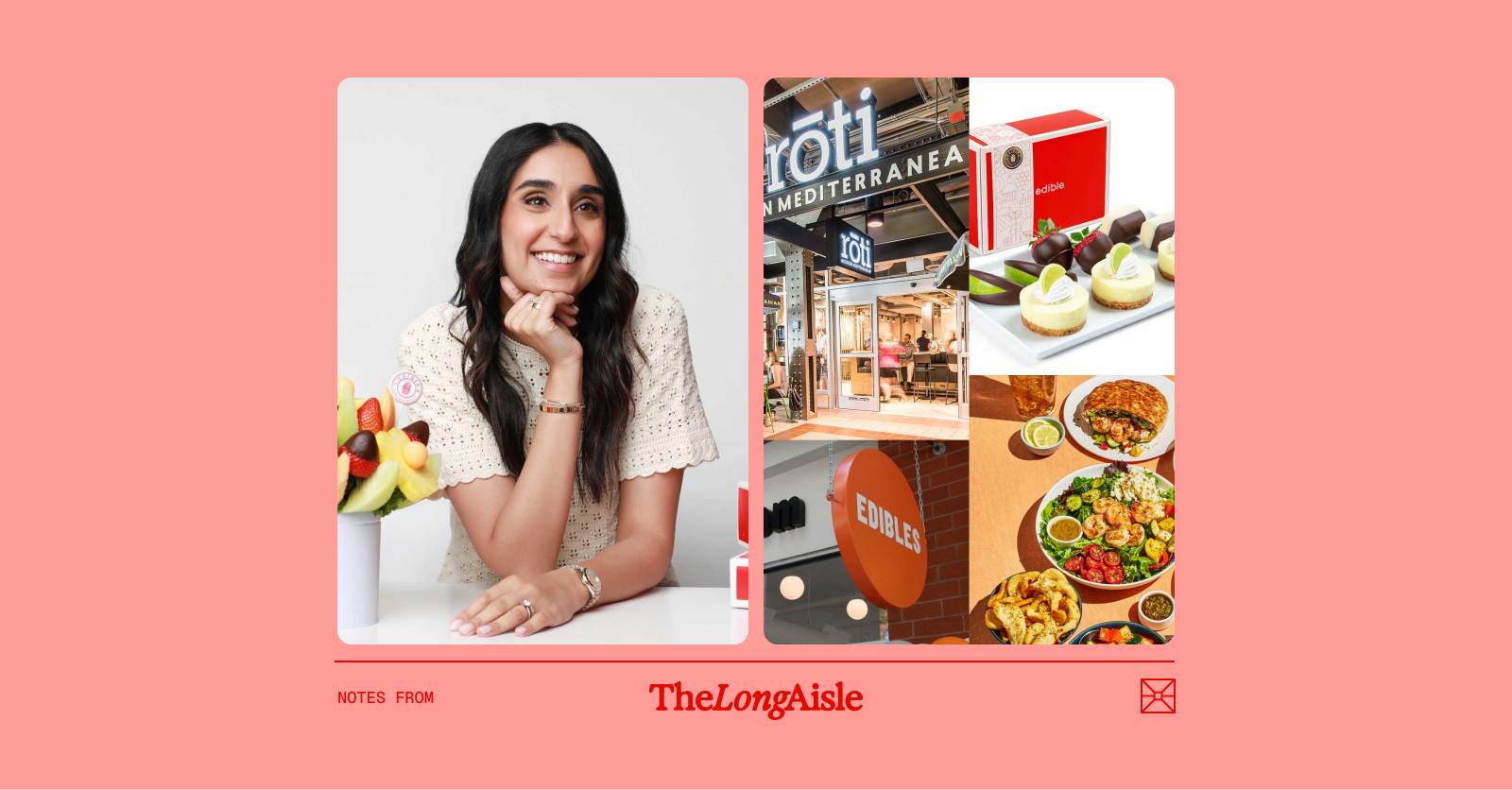
Somia Farid Silber of Edible Brands: Notes from The Long Aisle
This post originally appeared in my weekly newsletter, BL&T (Borrowed, Learned, & Thought). Subscribe
Borrowed
“I would, for example, never work in the yard unless I had at least one—and often two—kids hanging on to the handle of the mower. For the longest time, they weren’t really helping at all. Pushing a lawn mower with children hanging on, barely able to touch the ground, didn’t make mowing easier. But that didn’t matter.”
From “How Will You Measure Your Life?” by Clayton M. Christensen, James Allworth, and Karen Dillon [Book]
Learned
Edible Arrangements started on a counter in the back of Tariq Farid’s flower shop in Connecticut in the 90s. His daughter, Somia Farid Silber, was 6 years old when the first store opened. She spent her childhood skewering grapes, wrapping arrangements, running deliveries, and taking orders. If you ask her, she did all of this because she was interested. She was always there anyway, and she liked “getting to hang around the adults.”
In 2024, she became CEO of the same company her dad had spent 25 years building, about two years after her daughter was born.
The company is bigger than the arrangements business now. Edible Brands acquired Rōti, a Mediterranean restaurant, in 2025. Somia is also the CEO of Edibles.com, a marketplace for hemp-derived products that made headlines when it launched and now has a retail store in Atlanta, GA.
I pass an Edible Arrangements every day when we drop the kids off to daycare. I didn’t know too much about the business, except that when I’d had the opportunity to enjoy a fruit bouquet, I’d always enjoyed it.
Edible Brands came on my radar when Barrel had the opportunity to redesign and migrate the Rōti website to Shopify this year. As I learned about the parent company, I became more and more interested in the story. I was grateful for the opportunity to chat with Somia and hear about what it’s like to run the family business she grew up in.
Here are takeaways from our conversation.
Learn the business from every seat before you run it.
There was never a formal conversation where Somia’s dad told her she’d be leading as CEO. Instead, she spent 10 years working in every aspect of the business, from serving as a product owner on back-office applications to running the family’s IT company in Atlanta to an operations role managing a region and working directly with franchisees, then to running the e-commerce business unit.
“It’s really good to get a variety of experience because I understand the ins and outs of all of the different functions. It allows me, I feel like, to hire appropriately and hire the best people for those roles. And it also allows me to jump back in when I have to. So I’m able to decide when do I need to be strategic versus when do I need to jump in and be tactical.”
When I look back at my own trajectory (from designer to creative director to several other roles, and eventually CEO), I can relate to Somia’s. I didn’t work in every area of Barrel, but I got exposed to what it was like to work on all the different sides of the business I’d go on to lead. So much has changed about who we are and how we operate, but I know what it feels like to present my work to a client or do rigorous testing on a site I designed. This experience informs how I lead every day.
My first real job was at Wegmans, and similarly, as part of onboarding, they had us spend time in every department. What that gave me wasn’t skill in any of them. It was knowing how the different departments served the customer that changed my understanding of the store and how things worked, especially as I moved into a Coordinator role.
We don’t require new hires to spend time inside every discipline at Barrel, and there’s no way for everyone to get hands-on everywhere. We’ve done lighter versions in the past, where new hires would sit in on other teams’ meetings. This has got me thinking what the right balance looks like going forward because I do see a ton of value in the exposure.
A little gray is fine if you leave room to learn from it.
Somia and her dad make decisions differently. He goes with his gut; Somia looks for the data.
“I am sometimes too data-driven. I like the data to be very perfect, and I’ve had to learn to be okay with a little bit of gray so that we can be more nimble as a team and move faster.”
She added that her dad has always been good about giving runway for mistakes, so they get treated as learning. That’s what makes the gray tolerable. Moving before you’re certain is only reasonable if being wrong occasionally isn’t fatal.
At Barrel, one of our maxims is “every setback is an opportunity.” I’d say I fall somewhere between Somia and her dad, depending on the situation. Before I take action, I always try to understand the contributing factors and the risk. Can I accept the outcome if this goes sideways? It’s funny how sometimes it’s the things that go wrong that lead us to the next great thing.
But saying it and doing it are two different things. A setback only becomes an opportunity if someone takes the time to look at it, which means slowing down, debriefing, and aligning on the lesson. Without it, the maxim becomes a nicer way of moving on from an unfortunate situation. We’re generally good about this; the difference usually comes down to whether anyone owns the conversation.
Get the 360 view before you hit go.
The hardest decisions in Somia’s world are the ones with many stakeholders. Something can be right for the business and wrong for the franchisees who fulfill every order, and she’s been on the wrong side of that call before. Her process now starts with the leadership team, since no leader there makes a decision in a vacuum, and then extends to a group of franchisees before anything goes live.
When they rolled out a new POS system across store locations, that meant walking through how it was going to go down and asking what was missing.
“We always loop some of our franchisees in to make sure that we are getting a 360 view on that initiative or whatever we’re working on, which I also learned very early on.”
She isn’t asking for approval. She’s asking what’s missing from the training and what’s missing from the communication, because the person standing behind a counter on launch day will see things nobody in the planning meeting would.
This is everything for me when we roll out big changes at Barrel. Writing the memo and sharing the announcement in an all-hands meeting are the easy parts. What actually makes it work is the one-on-one conversations across the team beforehand, hearing where someone’s head is and what they’re worried about before it becomes a decision they’re reacting to.
We do the same thing for clients. On projects with larger teams, we’ll start with stakeholder interviews across the team to ensure the work is anchored in real use cases. In new business, we’d rather spend time going deep upfront than jumping to a project that won’t actually make an impact.
Do the pre-work so the meeting can be for decisions.
Somia’s C-suite meets every other week, and the full leadership team meets on the off weeks. One-on-ones run at whatever cadence the leader actually needs, from 30 minutes weekly during a big project to an hour a month otherwise.
Every six months they revisit the whole system. Sometimes that means too many meetings and having to figure out what to scale back. Sometimes it means noticing a topic that never gets airtime and finding where to weave it in. She says she doesn’t really have scheduling problems, which I found remarkable for someone working across three businesses.
“Wherever we can do pre-work, we always do, just to make sure that the time we’re together is truly focused on making decisions and helping remove roadblocks versus just talking about what’s going on.”
I’ve adopted agendas for the teams I lead, and for the most part, that works well. What we don’t do is pre-work. Nobody arrives having already read the things we’re about to discuss, so we spend more time in these meetings talking vs. deciding.
I’m interested in exploring how we adopt Somia’s approach across leadership and, really, everywhere in the org, because the meetings where everyone shows up informed are primed to be that much more focused and action-oriented.
The other piece is the 6-month review. Lately I’ve been thinking about where my time goes and wondering if my calendar needs a fresh approach. It feels like a bold move when it impacts more than just me, but is it worth hanging on to something that isn’t working? The regular review is a great way to ritualize this.
Hire for entrepreneurial spirit.
Somia’s perspective on hiring:
“The number one thing that I look for when I’m hiring is the entrepreneurial spirit. Because we run a very lean team for the size of our business and our leaders are required to be able to drive their business and their P&L forward and make those decisions. And that doesn’t mean that you have to go start a business of your own, but if you have that skill set, it does really well in an environment like ours.”
She isn’t the first guest to share a version of this. It comes up in teams and brands in all shapes and sizes.
What I like about how Somia puts it is that she separates the trait from the resume. You don’t have to have started something. You have to be willing to own an outcome, have a perspective, and be wrong sometimes without it throwing you.
This aligns very closely to how I think about the team at Barrel. For me, it’s true of every leader, from intern to director. It’s not easy to screen for, because everyone’s learned to say they’re proactive. Usually, what I’m listening for is a story about something someone fixed that nobody asked them to fix, and openness about where they’ve gone wrong and where they’re growing.
Be where you are.
Somia talked about life before her daughter. She and her husband had laptops open at the dinner table and phones out through the meal. Now her daughter is at the age where she wants to talk about her day, and that only works if someone’s actually listening. She calls herself a type-A multitasker who’s had to unlearn it.
“There’s times where there’s an initiative or a meeting or a person who needs your undivided attention and it’s really important that you give that to them when they need it.”
She protects the edges to make it possible. Her calendar is blocked until 9:15 or 9:30 so she can do drop-off; she’s home by 5:30 when she can be, and some nights the laptop comes back open after bedtime, which she’s fine with because, in her words, it’s the season she’s in.
I remember being that person before kids, too. And honestly, the pull to multitask is still very real at home and at work. When I’m on Google Meet calls, it’s easy to get lost in an urgent email or Slack message while someone’s talking. Back when we’d ask to keep computers out of conference rooms, this was much easier to do.
I like how Somia relates the focus with her daughter to what’s needed with her team. It was a good reminder for me. The person across from me in a one-on-one can tell when I’m half in my inbox, same as Mylo can tell when I’m not fully with him in play. Both need me.
Let your kids see you building.
Somia grew up hearing about business at the dinner table because her family believed everyone should understand how it works and how decisions are made. As a kid, she heard her dad on calls with vendors and franchisees, always asking what they were about.
"I don't feel like I was forced into it, but I was always there. I remember being eight, nine, ten years old and hearing phone conversations with vendors or franchisees and then always asking the question, what was that about? What were they talking about? And now I know all of that was all kind of done by design."
She only recognized the design years later. Nobody sat her down and explained the business. She was in the room while it was being built, and she got curious enough to ask. That’s what led her to running it now.
And it’s happening again one generation down. Her daughter is almost four and watching her Mom lead the business every day. She already knows the signature Edible Arrangements red packaging, and asks if there’s a strawberry inside for her when Somia comes home from work.
I think about this as a dad. Mylo and Cora need my attention, and I want them to see me building something. Those pull against each other more than I'd like. Give them everything, and they never see the work; let work consume me, and I'm the dad on his phone at dinner. It's inspiring to see how Somia's dad found a version of it that made her want in rather than resent it.
Check out “Ep. 6: Edible Brands · Somia Farid Silber on Taking Over From Her Dad, Talking Business at the Dinner Table, & Learning Presence From Her Daughter” wherever you listen to podcasts:
And if you enjoy it, rating, reviewing, and sharing make a real difference this early on.
+
More on this episode at: https://www.thelongaisle.com/episode/edible-brands-·-somia-farid-silber-on-the-unspoken-handoff-from-her-dad-hiring-for-entrepreneurial-spirit-learning-presence-from-her-daughter
Thought
Who got a version of me that was half somewhere else this week?
Which seat (in my team) would teach me the most right now?