Loren Castle of Sweet Loren's: Notes from the Long Aisle
This post originally appeared in my weekly newsletter, BL&T (Borrowed, Learned, & Thought). Subscribe
Borrowed
“But there is much more to life than your career. The person you are at work and the amount of time you spend there will impact the person you are outside of work with your family and close friends. In my experience, high-achievers focus a great deal on becoming the person they want to be at work—and far too little on the person they want to be at home.”
From “How Will You Measure Your Life?” by Clayton M. Christensen, James Allworth, and Karen Dillon [Book]
Learned
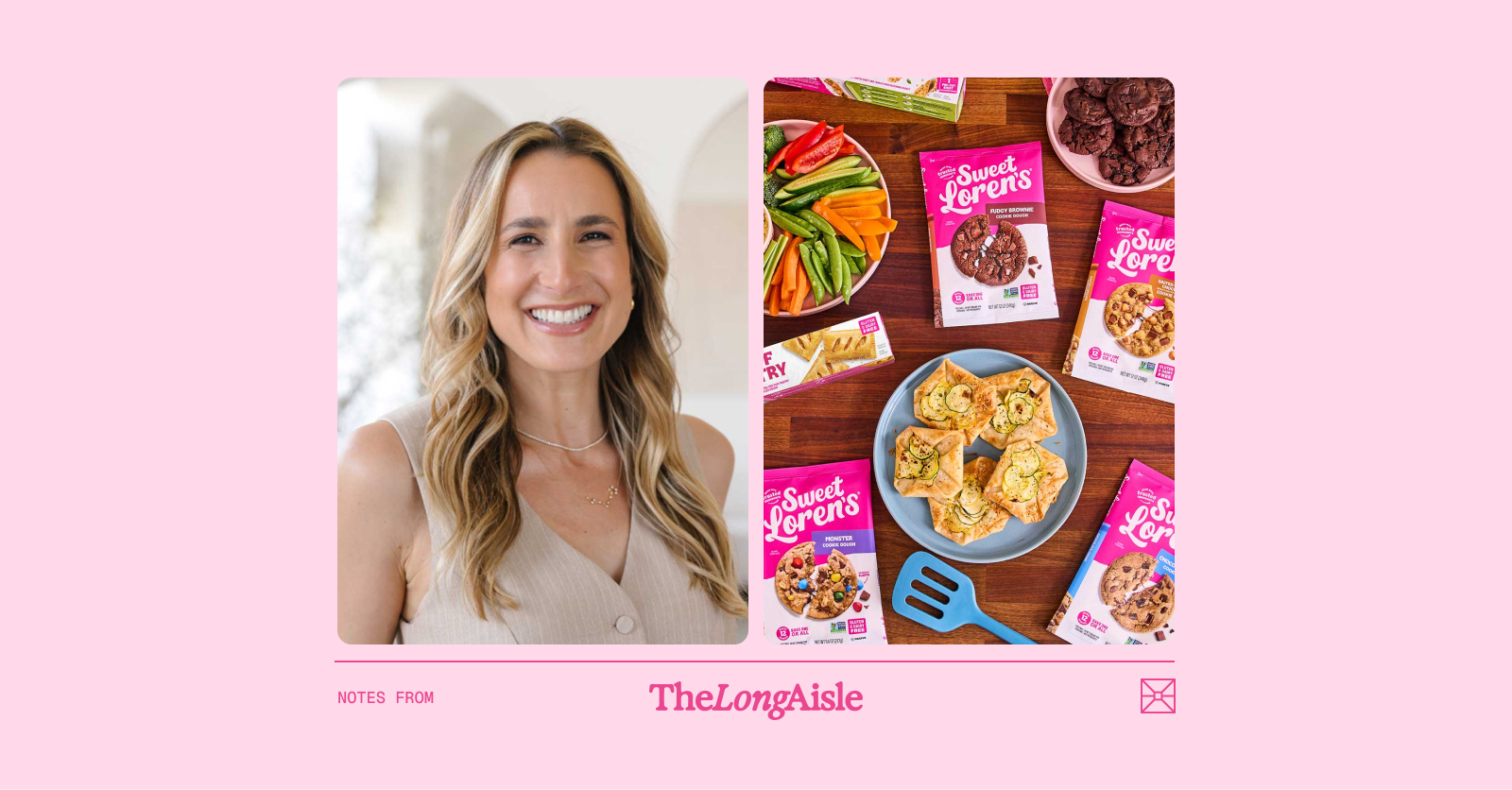
I first discovered Sweet Loren’s back in 2020, early in the pandemic. I was at Whole Foods looking for something sweet, but not super unhealthy. I grew up on break-and-bake cookies, but loved how simple the ingredients were in Sweet Loren’s cookie dough. Then I read Loren’s story on the packaging, how she’d started making the dough after going through cancer treatment at 22, and came home telling my wife Dana all about it.
Maybe a year or so later, Sweet Loren’s became a Barrel client. They were starting to expand beyond cookie dough and needed a new site to reflect this new phase of growth. I was psyched for us to be part of bringing that to life. Years later, Loren Castle, founder/CEO, joined me on stage at Expo West with Meredith Norrie of Mattel to discuss Sweet Loren’s collaboration with Barbie, their first-ever brand collab. So I’ve seen the brand grow from a few different seats over the years, but this was the first time I got to sit down with Loren and talk about her.

Loren started Sweet Loren’s in her mom’s kitchen in New York in 2011. Fifteen years later, it’s the #3 cookie dough in the country, in about 35,000 supermarkets. She’s also had three kids in the last five years. When we recorded, she was just months out of her third maternity leave. We talked about how this one differed from her first and what it’s looked like to go from building the business alone to building a family alongside it.
This conversation especially landed for me because of where I am in life. I had my second paternity leave in January. Just as it was ending, we were facing several challenges that quickly pulled me back into the work a few days early. That can always happen, but as my family grows, I’m often thinking about how to build systems that let the business move and grow without me being a bottleneck.
I think of it as creating leverage, for myself and for the team, so each of us can spend more time on what we do best. For me, that’s service development, strategy, and the parts of the business only I can do, which is much of what Loren described when she talked about where she spends her time now.
Loren describes it two ways. She talks about building the business around what makes her happy, and about still feeling responsible, no matter how far she gets from the day-to-day. I feel the same. One of her most important hires was her president, Doug. Earlier this year, I hired Sara as COO. It was a major hire for me and has been great to have someone to build alongside. I hope to look back on it much the same way.
Here are some excerpts from our conversation that I’ll continue to return to:
- Find your number two: “[My first maternity leave] didn’t really happen … What I realized was I didn’t truly have a number two at the company that could absolutely step in for me … I can’t be a mom and an involved mom and also be the one solely responsible for running the day-to-day of the business.”
- Let the departments run without you: “There are people way smarter than me that can work on [R&D] on a daily basis and create all new products … What’s great for the ego to see is, as long as I’m involved in a certain way, these departments run better when I’m not in them on a daily basis.”
- Stay responsible, and build the system that lets you: “You hire people and you put trust in them, but at the end of the day, I still feel responsible for the success of the business … So I’m trying to constantly figure out how to make these systems work even better, where I join two big meetings a week, one with our whole team, one with our leadership team, so that every week I feel like I have a very high touch point with our team and each department. [We’re] building dashboards for each department so that, again, I’m not in the supply chain day to day, but hearing the updates weekly.”
- Hire for the hard climb: “[What I’ve continually worked on is] how to find the right people that are passionate about changing the food industry for the better, that want a challenge, that know nothing great happens without a hard climb … There’s different kinds of people out there. You either love that or that’s kind of too overwhelming and exhausting. And when you find the entrepreneurial people that are so passionate about this, I think it’s our job as leadership to constantly help coach them, push them, support them, believe in them, because otherwise it’s lonely out there.”
- Only launch the 11 out of 10: “I don’t want to launch it unless it’s so delicious and loved by the consumer. It’s just not worth the work … It takes just as much work to launch a product that’s gonna be mediocre as it’s gonna be an 11 out of 10.”
- A dozen of the same message isn’t random: “I had no access to data or research. My only data was human behavior, [demoing at one Whole Foods] and really hearing honest feedback, both positive and negative, about the product and about the packaging, over and over again. And once you heard from a hundred people, and maybe there was a dozen or twenty of the same messages, you knew it wasn’t random.”
- Don’t judge it at the end of the day: “In the early days when I was exhausted or overwhelmed, I always leaned on my friends or family to be like, am I crazy for doing this? … This would always happen at the end of the day, when I was just exhausted and everything looked harder and darker than it was. And then I would wake up in the morning after a good night’s sleep and something great would always happen within 24 hours.”
- Bigger doesn’t mean easier: “Almost like the bigger the business gets, you’re like, it gets easier. It gets harder in many ways too, because more is at stake. You sometimes need a different type of team. The scale is way bigger … We all know we didn’t sign up for easy.”
- Treat it like a real business from day one: “This can’t be like a cute little company. If you’re gonna not work for someone else and get a salary, you really have to figure out how to build a business that’s gonna be able to take care of you. And I’m gonna start charging you rent next month.” That was her mom, six months before Sweet Loren’s launched and a couple of years after Loren finished chemo.
- Five minutes of undivided attention: “[My mom] put each of us three kids to sleep, even if it was only five minutes for each kid separately. She gave us this undivided attention where we just, I think, felt like the most special person in the world and really connected … I don’t think she ever came to my track meets or soccer practice … But I think we all felt incredibly close to her.”
- Let them see a happy parent: “I think if [your kids] see a happy mom and a happy dad, that is the most important thing … What they see is a happy, strong parent who likes to work hard and has responsibility. And so I think she’s already learning things without me even sitting down and teaching her.”
- Fill your cup first: “If I don’t fill up my cup to the top, top, top, everything else falls apart … What is self-care for me? Because it’s not selfish. I think if I do the things that I need to just make myself feel great, then I can give much more to my kids. I have so much more patience.”
- Decide what success has to include: “If this business is super successful, but I don’t have kids, friends, a great husband, I will not be successful. My life is not successful … The business is my first kid. It’s something I’m so passionate about, but at the same time, it’s not my whole life.”
+
Listen to the full episode with Loren:
If it resonates, please rate, subscribe, and share. It goes a long way. Thank you!
+
More here: https://www.thelongaisle.com/episode/sweet-lorens-loren-castle
Thought
Where am I still in the room when I don’t need to be?