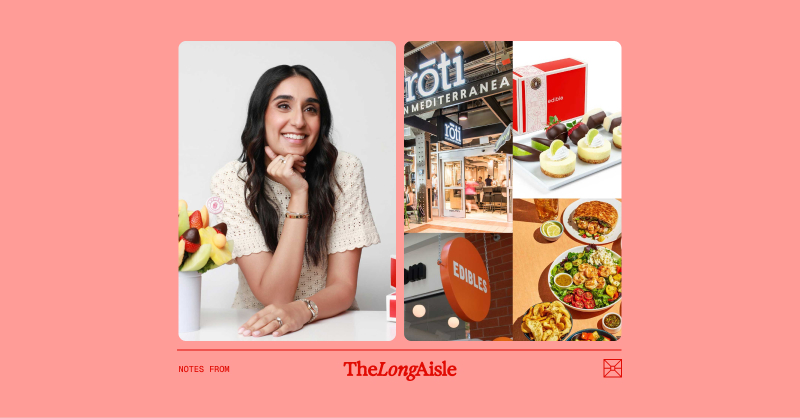
Anna Zesbaugh of Corpse Reviver: Notes from the Long Aisle

This post originally appeared in my weekly newsletter, BL&T (Borrowed, Learned, & Thought). Subscribe
Borrowed
“If you’re ready to scale, sunk-cost bias can’t be your game. You can’t keep holding on to what was, just because you’re invested—maybe even heavily invested. The question isn’t whether you were previously holding a winning hand. The question is, is it still a winning hand? In order to scale, you’ve got to become a pro at letting go.”
From “The Science of Scaling” by Benjamin Hardy, Blake Erickson, and Tony Robbins [Book]
Learned
At the start of the pandemic, the mayor of Denver shut down every liquor store in the city and called them non-essential. People lined up around the block to stockpile, sure it would last weeks, then a few hours later, he went on the news and took it back. Meanwhile, Anna Zesbaugh was 24, recently furloughed, and getting antsy. This time became known as the Denver prohibition, and out of it came the name for her first business: Hooch Booch, a hard kombucha she started with, in her words, nothing to lose.
That was the first of three businesses she’d start over the next six years. Hooch Booch, then Blind Tiger, a full bar, then Corpse Reviver, a non-alcoholic sparkling drink named after the old hair-of-the-dog cocktail, and flipped to hydrate and refresh you. In 2025, she closed the first two to bet everything on the third, which is now on shelves at Walmart, Whole Foods, and Erewhon. At the time of the interview, she was in the early stages of planning a 25-day Costco road show that would dominate her summer.
It was a pleasure having Anna on the show. What I appreciated most was her ability to be reflective while I know her life is moving at full speed. She holds the data as closely as the passion she brings to the work. She's honest about the highs and the lows, and she carries a hunger to learn from both.
Revisiting my conversation with Anna was a nice reminder of why I do this show. Here's what I took away from our chat.
Let the data make the call your heart can’t.
The decision to close Hooch Booch wasn't sudden. Anna recognized that the alcohol category was softening, people were drinking less, and it took constant education just to get someone to take a sip. She had loyal customers, which made it harder, not easier. So she posed the real question to herself: was she willing to keep pushing that boulder up the hill every single day, forever? The brand was her firstborn, but she knew that wasn't enough to hold on.
"It was my first born child, but at the same time, in business you have to think about things. I won't say less emotionally, because there's always going to be emotions involved. But it's almost like taking that aside and just saying, can we use this data to tell a story?"
I've contended with this more times than I can count, in ways big and small. The small version played out just recently, when we finally cleared out a bunch of our stuff from our time in Brooklyn. It had been sitting in a box in the basement for years. Some of it was sentimental, and I still had to talk myself into letting it go.
The hard version looks like the layoffs we went through years ago at Barrel, when we made the difficult decision to downsize the team to keep the business healthy, something I've written about openly since. What I remember most isn't the numbers that made it necessary. It's how much harder it is to act on a decision you know is right when you can feel everything it costs. That's the part Anna names so well. The emotion doesn't go away. You just can't let it be the thing that decides.
Listen closely, and your customers point the way.
Anna didn't dream up Corpse Reviver in a vacuum. Running a bar for three years gave her a live testing ground, watching what people actually reached for and asking them why. She calls it "liquid to lips."
"We as founders get really stuck on our own business idea and why we think our business idea is so good. But listening to the consumer will dictate where they want to go."
The product itself came out of that habit. While she was still running Hooch Booch, she polled her customers and kept hearing they couldn't find a better-for-you hydration option, which put her ahead of a movement that's everywhere now. They told her what to build before she built it.
I try to do the same at Barrel with our clients and prospects. Leading with curiosity. Staying close to them, understanding how our work is landing and where they're setting their sights next, is how we've grown our offering over the years. But there's a nuance to it. It's not about waiting for clients to hand you the answer. It's about understanding their challenges well enough to see what they need before they've named it, and knowing how to solve it.
The team that got you to year three can't get you to year five.
Anna hired her friends early, which, in her words, "I would not recommend. It's a weird power dynamic when you're a boss of a friend. It's really challenging." She also hired green, hungry people who would pound the pavement and drop samples door to door. That got her far, but she recognized it couldn't get her to the next phase of growth, where landing at Costco ideally means someone who has already navigated what it takes.
"What works in year one to year three is not the same year three to year five. I heard that a lot, but I don't think I understood what that would feel like."
This one hits home. For a time in Barrel's history, we were all about hiring junior folks and shaping them into bigger roles. It's still important for building a well-rounded team, and I'll always believe in betting on people. What's evolved is the recognition that certain seats call for senior people whose experience already maps to where we want to go.
Part of that, for me, has been learning to hire people stronger than I am in the areas I'm weakest, and to want that, not fear it. I'll never stop growing and learning myself, but if someone can get us somewhere in weeks or months that would otherwise take years, that's an enormous win, and the only thing usually standing in the way is ego. Setting it aside is part of the job. Knowing what your vision demands, and being secure enough to go get it, is its own kind of growth.
Trust the process, and treat rejection as redirection.
In 2020, recently furloughed and feeling low about filing for unemployment two years out of school, Anna signed up for her 300-hour yoga teacher training, a six-week online intensive. One week's lesson was about trusting the process. She wrote the phrase on a piece of paper and stuck it to her bathroom mirror, where it still hangs today. It's become the thing she returns to, especially in moments of rejection, reframing a no as a sign the thing wasn't the right fit and something better is coming.
"That mindset has really allowed me to let go of a lot of things that I would probably hold on to for a lot longer, because there's something better out there that I just haven't discovered yet. It's not even super business-minded, it's a little more life-minded."
I really enjoyed this part of Anna's story. It's incredible how a little piece of paper can hold that kind of power. So much of what I believe comes down to the idea that the right inputs, compounded over time, are what build something lasting, and that consistency beats perfection.
I've felt my share of setbacks this year, some I never could have seen coming or thought I'd have to navigate. It's hard to see the good in those moments while you're in them, but the belief that it's all part of the process and the belief in myself to keep going are what carry me through.
Looking back, it almost always makes sense. If this hadn't happened, that would never have happened. The person I am today is a culmination of all of it, so there's really nothing to do but accept each blocker, learn from it, and keep going.
Share the losses, because vulnerability is connective.
Anna is very active on social, writing and talking about all the highs and lows of building Corpse Reviver. When I asked her about it, her reason started with connection:
"Vulnerability is connective. When you bring down the curtain of entrepreneurship and show here's what it is and here's the heart… everyone on social, it's a highlight reel. It's look at this cool new retailer I got into, look at this cool new product I'm launching."
But underneath the connection is a desire to give back.
"I've fallen on my face 500 times. If I can share it with someone, like, here's how you could probably not fall on your face, if you read these five things, I want to be able to share that."
People read about two closed businesses and write back asking how to avoid the same holes. The act of helping is what opens the conversation. The surprise is that it isn't just good for the soul, it's good for business. She only started posting more honestly in the last six to eight months, and some real retailer opportunities have come directly from it.
I love the way Anna puts this. “Connective.” Running this newsletter every week for years has been my own practice ground for it, a standing commitment to reflect and share, whether or not it's polished. It wasn't always comfortable, still isn’t. When I was younger, I held things close, partly to guard an imagined edge, partly because I was afraid to share and didn't want the feedback. What I've learned since is that opening up never costs you as much as you fear. It invites people in.
It's something I've worked to build into our culture at Barrel. Our Tuesday agency-wide meetups are often just a single open prompt to get people talking, and early on, that meant sitting in some awkward silence and leaning into it anyway. Week after week of creating the space, it's evolved into something people now tell me they genuinely value, a rare space to actually share. I've tried to carry the same spirit outside of work too, into the men's group I started late last year, Denwork, and into this podcast. What you're brave enough to put out there is usually what brings the right people closer.
I've written more about practicing vulnerability here over the years.
Know the difference between the people you call and the people you pay.
Anna is a solo founder, so I asked her, half jokingly, if there were any silent co-founders we didn't know about. She mentioned her dad, a CPA who knows nothing about CPG but grounds her in the numbers when her creative side is spinning. Beyond him, there's a handful of business coaches she pays, all from CPG, people who have scaled teams and sold companies and can ask her what something looks like in five years. And then, on purpose, she keeps friends and family out of the daily swings.
"Those are the people that I call on the good days and the bad days. There's friends and other family members, but as much as possible I try not to rely on them for my highs and lows, the roller coaster that I live on every single day. People that I pay for that."
Talking with Anna left me sitting with how this shows up in my own life. The paid side I recognize completely. I've leaned on consultants and advisors in recent years, and there's real power in having those people in your pocket, someone with no stake in your day-to-day who can tell you the truth.
Where I land a bit differently than Anna is on the personal side. She guards her inner circle from the roller coaster, and to a degree, I do too with my immediate family, so I understand the instinct. But I've also found a lot of value in creating spaces for the hard stuff rather than walling it off. Sometimes at home, I'm too drained to get into the details of my day with Dana, but I'm always glad when I do; she sees angles I've missed entirely. Denwork has become another version of that, a group standing on common ground where I can open up.
Maybe that's what Anna and I share most. She talks about her work in the same breath as her life, the businesses, and the people, and the roller coaster, all part of one story. I feel the same. For me, work and life aren't two things to balance; they're one life, and when I let them, they inform one another in beautiful ways.
Keep a daily practice that gets you out of your own way.
For all the talk of data and decisions, the thing that keeps Anna steady is ordinary: doing yoga almost every day. It's the one hour nobody can reach her, and she can't touch her phone. It gets her out of her own head.
I don't do yoga regularly, but I know exactly what that hour is, because I protect one like it every morning. I won't bore you with the particulars, but it's a stretch of time before the day's demands arrive where I get to step back from the details and the doing. The specifics have shifted over the years, and they'll shift again as life evolves. The value isn't in keeping the routine perfect; it's in having a base to return to when everything around me feels unsteady.
I wasn't surprised to hear how Anna has created this space she protects. She's built the time into her day to process everything in motion, and it shows. I meet so many people who are deep in it, heads down, moving fast, with no time to breathe, let alone reflect or pull the lesson out of a hard week. The irony is that the busier things get, the more the space is worth it, and yet it’s often the first thing to cut.
Anna shared how one of her yoga teachers captured this paradox exactly:
"When you have time to meditate, meditate for ten minutes. And when you don't have time to meditate, meditate for twenty."
The work matters, but it isn’t everything.
For someone in the thick of building, Anna is clear about where the business ranks against everything else.
"No matter how busy I am or how much I have going on with my business, that I still showed up for them. No matter what."
She told me what that looked like. When she closed Blind Tiger, her grandfather passed away, and her mom was diagnosed with cancer. She told Kurt, her event manager, that she needed him to shut the place down, got on a plane the next morning, and flew home to Minnesota to be with her family. As she puts it, she's not saving lives, and the business could wait. The people couldn't. And to her, showing up means getting on the plane, not just sending the text.
"That's why I say I literally just sell drinks at the end of the day. It doesn't matter. You have to show up for your people."
I didn't always understand this. Early in my career, there were moments I didn't show up for the people in my life the way I should have.
In one job, I was afraid to even ask for time off. Later, as I was falling into leadership, I felt like everyone was counting on me, and stepping away always felt like a risk. I've since come to see that's not what makes a true leader. Then my pop-pop passed, someone I was very close with, and that's where all of this came into sharp view. I'll never forget standing in the office phone booth, taking the call, then dropping everything to go. No planning, no prep, I just left. And everything was fine. I'm so glad I didn't think twice.
Having kids has driven the lesson the rest of the way home. It's less about chasing some perfect work-life balance and more about keeping my priorities straight and being willing to act on them. It's something I believe in, and it's come up with a few recent hires who have families. When something at home needs you, you go, and the work will be there when you get back.
I try to be the same person in and out of work, with Dana, the kids, and the team. It's a welcome reminder that the long game isn't only about what I’m building. It's about the people in it, and whether I showed up for them along the way.
+
Check out "Ep. 4: Corpse Reviver · Anna Zesbaugh on 3 Businesses in 6 Years, The Note on Her Mirror, & What It Means to Show Up" wherever you listen to podcasts:
And if you enjoy it, rating, reviewing, and sharing make a real difference this early on.
& Thought
What am I still holding onto when the data's telling me to let go?