10 Things I'll Remember from the Philly Half Marathon

This post originally appeared in my weekly newsletter, BL&T (Borrowed, Learned, & Thought). Subscribe
Borrowed
“Plenty of evidence suggests that confidence is just as often the result of progress as the cause of it. We do not have to wait for our confidence to rise to achieve challenging goals. We can build it through achieving challenging goals. I have come to welcome impostor syndrome as a good thing, it is fuel to do more, try more. I have learned to use it to my advantage. I actually thrive on the growth that comes from the self doubt.”
From “Think Again” by Adam Grant [Book]
Learned
A couple of weeks ago, I ran the Philadelphia Half Marathon. Luckily the heavy rain cleared by the time the race began. Despite the wet conditions, the experience was a joy and one I know I will look back on with a smile. Rather than write about takeaways or lessons, I thought I’d write down the things I hope to remember years from now.
1. Choosing the Half
I decided to run the half because training for a full marathon last November required a lot of time, and with Dana pregnant with our little girl (coming so soon!), I wanted a goal that still pushed me but felt more manageable from a timing perspective. I decided to focus on training for speed and seeing how well I could do. I set an internal goal of 1:30, which is about a ~6:53/m pace. Based on my marathon, my coach built the training block with a 1:40 goal, but I kept my target in mind and figured I’d set A, B, and C goals, as I did last time.
Toward the end of the block, I was running three times a week with a long run on weekends, consistently waking before 5:15 in the morning, and continued strength training on the days I was not running. The ankle pain that put me in physical therapy earlier in the year never returned during training or the race, which was a huge win.
"In long-distance running the only opponent you have to beat is yourself, the way you used to be." (Haruki Murakami, What I Talk About When I Talk About Running)
2. Running for a Cause
Just before I signed up for the race, I finished another one of Dean Karnazes’ books, “50 Marathons in 50 Days.” He often talks about the power of running for a cause, and this book was no different. With a new race on my mind, his stories about running for something bigger than yourself got me thinking.
When I saw the option to fundraise for the American Association for Cancer Research (AACR) at signup, I decided to dedicate this race to people in my life and others who have been affected by cancer. This decision changed the entire training block. I was no longer running only for my own health and fitness, which gave me another level of energy on those cold, dark mornings where getting out of bed is the last thing I feel like doing.
I set a goal of $1,000 and am still amazed by how quickly we surpassed it, ending the fundraiser at $1,350. It was incredible to see everyone from acquaintances to folks I hadn’t connected with in a while to those I had just met all support my race. It’s powerful how a cause can unite people, and I’m proud of what we accomplished together.
3. Consistency & Confidence
Training for the marathon last year was a lot of firsts. By the time I toed the start line of the marathon, I had only been running seriously for about a year, with no real prior experience (outside an impromptu 10k years prior that ended with me on the couch, barely able to walk with shin splits). This time was different. I came in with more comfort in the process and confidence in what I could do.
In the latter half of my training, I consistently beat my target paces and felt strong overall. I also didn’t let anything stop me from running. I planned around times where I’d be on my own with Mylo and didn’t let inclement weather get in my way. I ran in the rain, ran on trips, ran whenever and wherever I needed to. Some of my favorite runs were in Brigantine, NJ where I got to do a 10-mile loop around the entire island and in Chicago, running along the waterfront. By race week, I felt ready for whatever the day might bring and genuinely excited to see what I could do. It just so happened I woke up to that heavy downpour on the morning of the race, but given my training, I felt prepared if it didn’t stop. Luckily, it cleared.

4. Stick With What Works
My first marathon taught me a painful lesson. I did an intense carb-loading cycle the week of the race, and while I can never know for certain, it was likely what wrecked my stomach by mile 5. As a result, I could not hydrate properly and paid for it the rest of the race, putting me in the medical tent with an IV post-race. So this time, I kept things simple.
During the week, I start every workout the same: a rice cake with jelly and espresso. While I knew I’d need more fuel to go all out in the race, I didn’t overdo it. I just dialed things in with a strategy. With Dana’s birthday festivities, I didn’t want to be a debbie downer and say no to things like sweets or pizza. Instead, I worked them into my diet.
I used my coach’s guidance and an ongoing chat with ChatGPT to build an hour-by-hour plan from the evening before the race to my fuel strategy during the race. This looked like a few more carbs the night before via sweet potatoes and rice, and overnight oats for breakfast at 4:30 AM.
5. Starting with Control
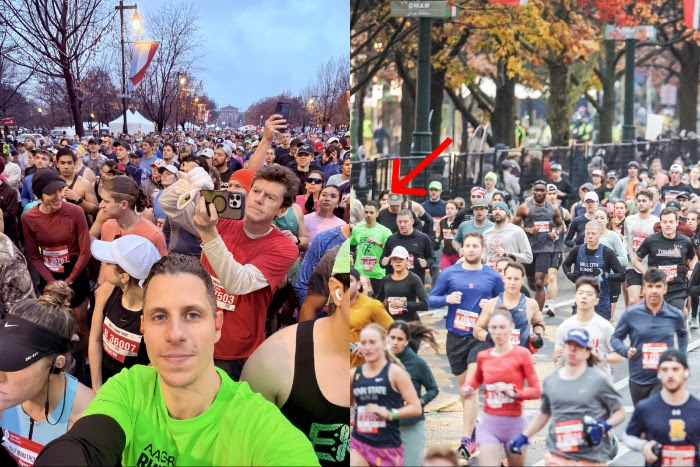
In the marathon, I learned how dangerous the adrenaline at the start can be. Everyone takes off fast, and it is easy to match the energy of the people around you, only to pay for it later. For this race, I also went in with a negative split plan, meaning I’d start slower than I’d finish. But this time, I am proud of how well I stayed in control. While the crowd surged at the beginning, I held back, settled in, and trusted I would regain speed later. It made the race more enjoyable and let me take in the energy around me.
Sure enough, many of the people who took off early slowed down, and toward the end, I ran among a small pack that seemed to have a similar plan.
In the last couple of miles, a girl in her early 20s definitely heard me grunt and cheered me on, mentioning she’d been watching me for miles. She and her friend passed the finish line just before me. I appreciated her positive energy when I started feeling drained, and I’ll admit, felt pretty good keeping pace with someone more over a decade younger than me.
6. The People
In my first marathon, the course was much more subdued. At times, I was running alone on the trail. There was something special about those miles, but this race felt different from the beginning.
Running for a cause sat in the back of my mind the entire time. I kept thinking about everyone I dedicated the run to and everyone who made it possible for me to be out there.
Then there were the runners. Nearly 12,000 people showed up on race day. Even in the damp cold, the streets felt alive. It was impossible not to feed off it.
Early on in the race, I exchanged a smile with a security guard. He looked so serious on the sidelines, but when we locked eyes, all I could do was smile. He lit up. It was a little moment that set the tone for the rest of the race.
Around the halfway mark, I saw my dad and brother cheering me on. For whatever reason, my instinct was to blow them a kiss. I had a smile plastered on my face for most of the race, up until those final couple of miles when things finally started to hurt.
Later, near South Street, families stood outside their homes handing out snacks while kids cheered from their front steps. Even in the weather, people showed up. It added a warm, local feeling to the day that I loved.
And then there were the runners who stopped me in my tracks emotionally. One runner pushed a disabled woman in a racing chair. Another pair moved together, one using a skateboard for mobility and the other running with a prosthetic leg. We shared a quick exchange as we raced that carried me for miles.
7. Running Through My Home City
I underestimated how meaningful it would be to run through a city that holds so much of my history. My family is from Philadelphia. I spent a lot of my childhood there. I met Dana at Tyler School of Art, part of Temple University.
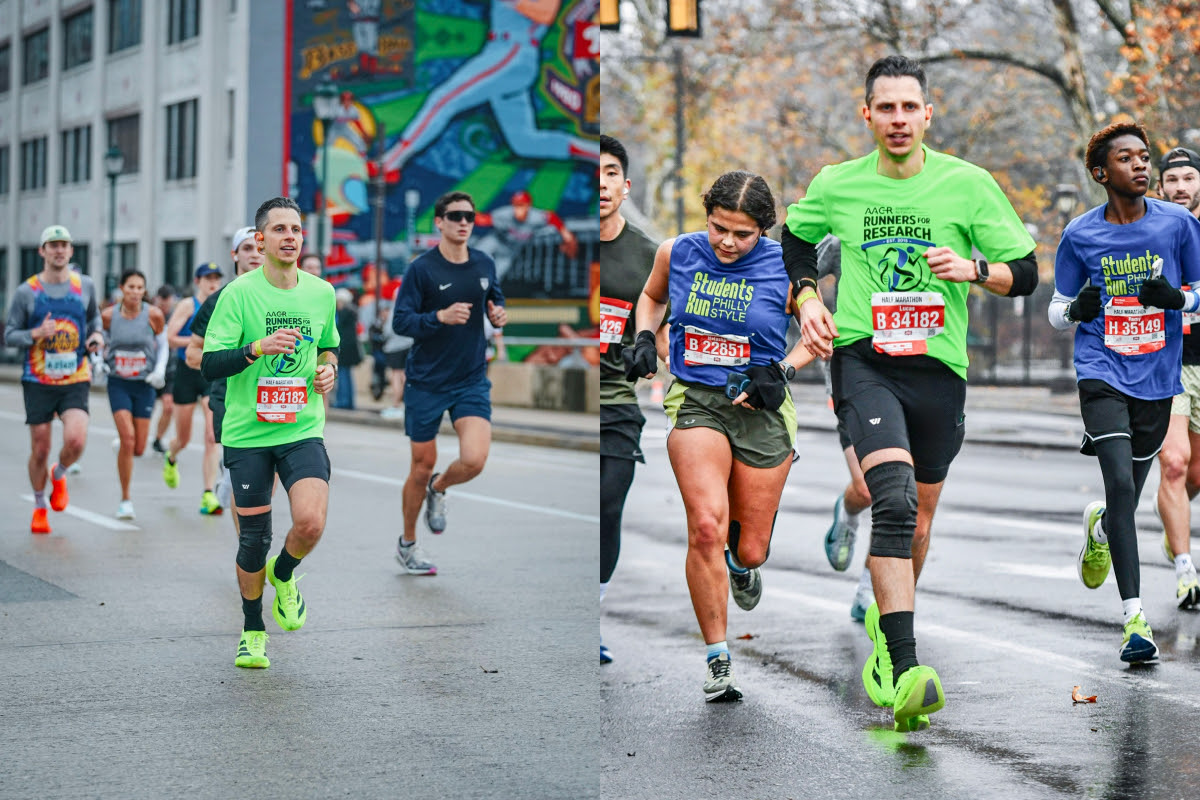
As I ran through different neighborhoods and passed familiar spots, memories kept surfacing. At one point, I ran into someone I had not seen since college, someone I used to work with at the Temple News, our college newspaper. He recognized me and yelled my name. It all made the race feel even more personal and affirmed how right it felt to have this be my first city race.
8. My Support Crew
A couple of months before the race, I asked my dad and brother if they would accompany me, but warned them it would mean waking up at 4 AM. They said yes, and on race day, showed up at my house at 5 AM on the dot in the pouring rain to drive me to Philadelphia.
When we got there, they could not get inside the race area, so they stood in the cold drizzle until the race began. They were positive the entire time. Not one complaint.
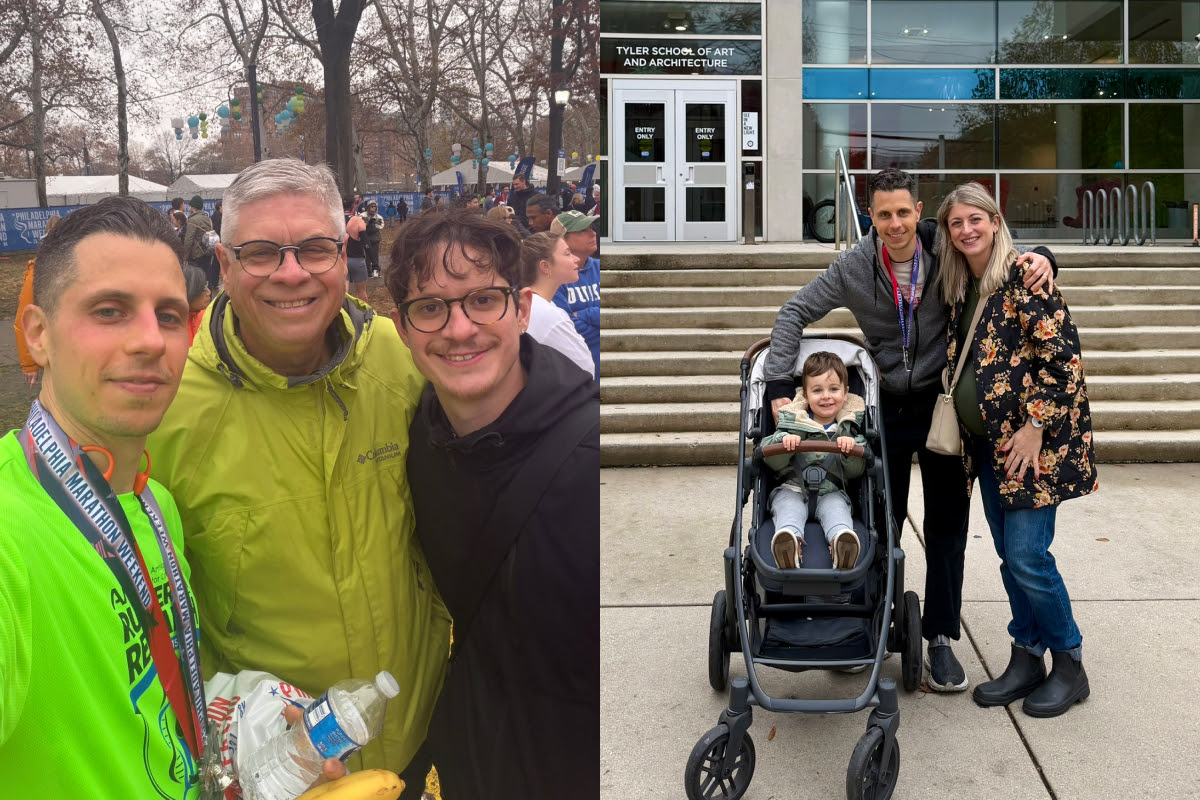
After the race, they congratulated me, and we spent time together in the AACR tents, eating bagels and snacks, talking through the run. I am grateful for their support and willingness to be there with me, and for the time together, which I will cherish for a long time.
Note: I’d later pay the price for eating everything from peanut chews to a bagel with peanut butter and chocolate chip muffins post-race on an already funky stomach. While I wasn’t dehydrated this race, my stomach was in knots until early Sunday.
9. Claiming the Progress
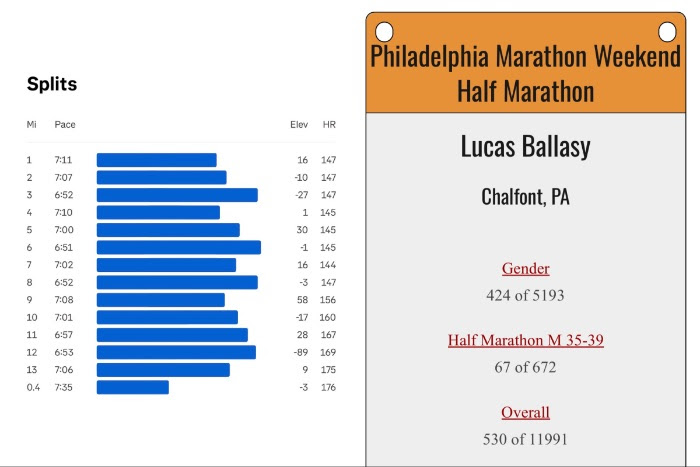
In this race, I learned how much your official finish time can vary with what your GPS watch shows. While the course measures 13.1 miles, your watch captures all the weaving and extra distance. My watch showed I raced a 1:31 half marathon, while my official time was 1:34. Even so, I placed 530 of 11,991.
All said, I am proud of how I ran. That’s what I love about these pursuits: you compete with yourself. Considering I only started running two years ago, I have carried a lot of imposter syndrome around calling myself a runner. Finishing where I did and averaging close to 7:00/mile helped me finally feel like I earned it. Another experience that showed me how much I can do with focus and effort. I can now call myself a runner without cringing inside, which feels pretty good.
"Only those who will risk going too far can possibly find out how far they can go." (Dean Karnazes, Ultramarathon Man)
10. Mylo on My Mind
The night before the race, Dana went out with a close friend for an impromptu birthday dinner, so it was just Mylo and me. Before bed, I told him I’d be running the next morning and that he and mommy would meet me for brunch with friends after. He repeated it back as best he could, and I wondered if he understood.
I thought about him a lot during the race. I run to challenge myself, but in the end, what I really want is to stay healthy and strong for my growing family.
For months now, Mylo has been loving the musical artist (or modern day rockstar) Yungblud. I played a few songs for him one day, showed him a video, and he latched on immediately. I usually listen to audiobooks on long runs, but for this race, it felt right to run with Yungblud in my ears the entire time.
Toward the end, when things started to get hard, I put on his favorite song, “Hello Heaven, Hello,” and let it drive me through the final stretch.
After the race, I met up with Dana, Mylo, and a couple of friends. When I first saw Mylo, he looked at me from his stroller and said, “Good job running Daddy.” It was the perfect ending to this journey.
A Final Note
Looking back, what stands out to me is how the race fit into a busy life and weekend. It was Dana’s birthday, so it felt like a good reason to celebrate all weekend with people we care about. As much as I wanted the race to go well, I did not want it to overshadow the rest of the weekend. I have never made reservations 4 days in a row, but there's a first for everything!
- We started on Thursday, Dana’s actual birthday, with a surprise dinner at a local pizza place with family and friends.
- On Friday, we drove to Philadelphia to pick up my bib and stopped at Dizengoff for lunch. Dana went out that night, and I stayed home with Mylo.
- Saturday was the race, followed by lunch at Square 1682 with old friends and a slow afternoon walking through the Philadelphia Christmas Village before revisiting our alma mater, Tyler School of Art. Being back there with Mylo and Dana’s friend from college was special.
- On Sunday, we met friends for a Thanksgiving-style brunch at a campsite, and that night, wrapped it all up at Forsythia before heading to see one of Dana’s favorite bands, The Academy Is, for their 20th anniversary tour.
During training, I had moments when that familiar feeling crept in, wondering how something that takes so much discipline, time, and energy can fit alongside everything else that matters, and if it should. This weekend was a reminder that you don't have to choose. It does not have to be one or the other. I am grateful for Dana’s support and how we continue to shape a life that feel connected and full, even with personal pursuits and interests in the mix.
The race was part of the story, not the whole story. And maybe that is what I will remember most as life continues to evolve and get more complex. You make it fit. You make it work.
While I’m not sure what comes next, I’m inspired to just keep running.
"Doing your best means being dedicated to putting in the work, dedicated to meeting your goals. Often the most effective way to do that is to quietly but consistently go about your business at a sustainable level." (Meb Keflezighi, 26 Marathons)
+
Related: Why I'm Running for Cancer Research, Instagram Post, Reflections from my First Marathon
Thought
When was the last time I let myself be proud of how far I have come?