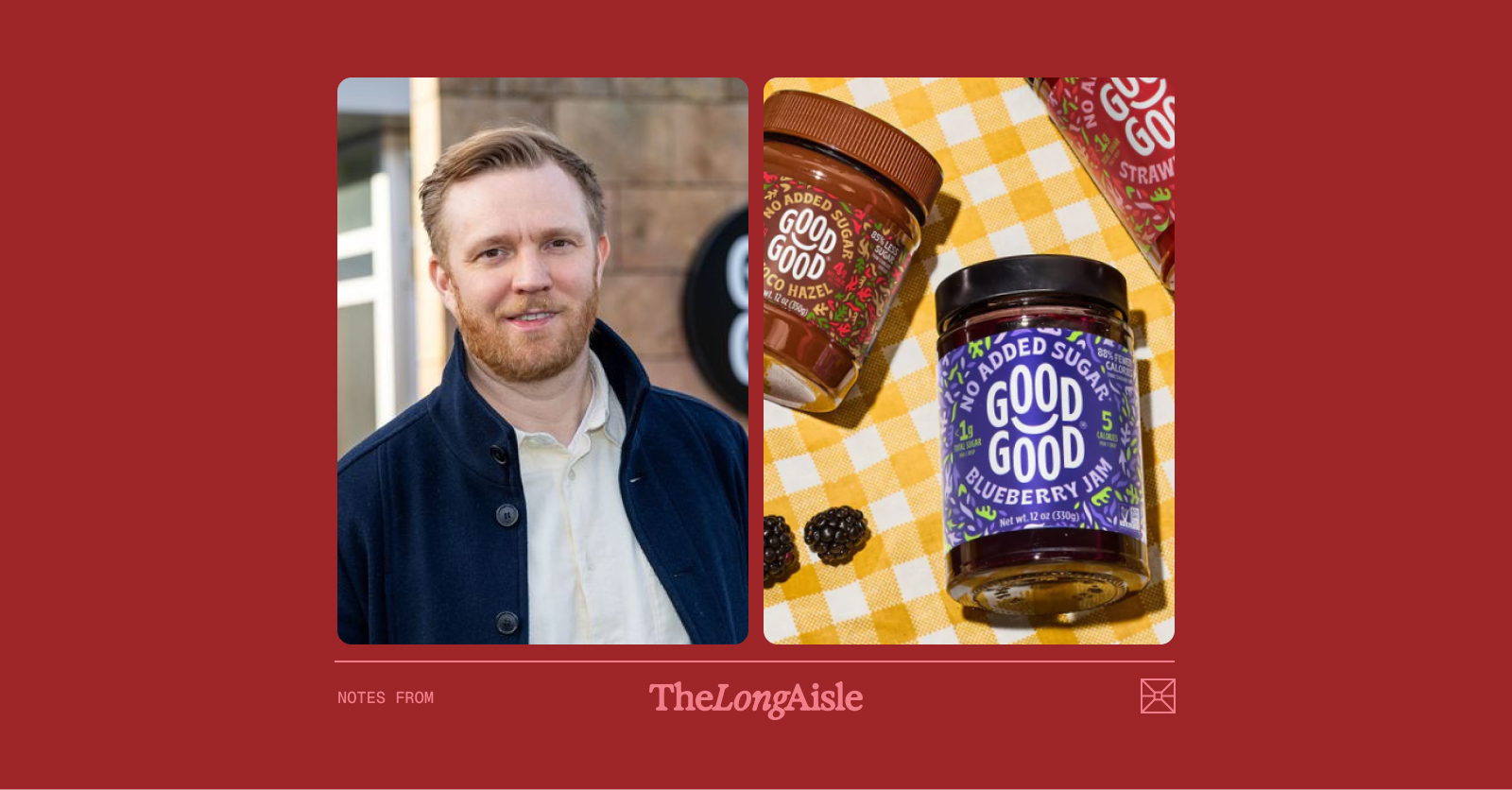
Gardar Stefansson of GOOD GOOD: Notes from The Long Aisle
This post originally appeared in my weekly newsletter, BL&T (Borrowed, Learned, & Thought). Subscribe
Borrowed
"Pain is inevitable. Suffering is optional. Say you're running and you start to think, Man this hurts, I can't take it anymore. The hurt part is an unavoidable reality, but whether or not you can stand any more is up to the runner himself. This pretty much sums up the most important aspect of marathon running."
From "What I Talk About When I Talk About Running" by Haruki Murakami [Book]
Learned
I doubt I’d be writing about any of this if my mother-in-law hadn’t taken a chance on a new jam a few years back. I remember visiting my in-laws in Delaware when I came across a jar of GOOD GOOD in their pantry. I looked at the label, way less sugar and calories, then put it on some toast, and I was hooked. Sadly, I couldn’t find it anywhere back home for a while after that, so when I spotted the booth at Expo West last year, I jumped at the chance to introduce myself. The rest, as they say, is history.
That’s what’s so fascinating about CPG. You can do all the marketing in the world, but sometimes it’s a chance encounter, like a jar in someone’s pantry, that turns someone into your biggest fan. Luckily, GOOD GOOD is now at my local Whole Foods, and I start every morning with their jam.
All said, I had the pleasure of sitting down with Gardar Stefansson, co-founder and CEO of GOOD GOOD, for Episode 2 of The Long Aisle to learn more about his mindset, his leadership style, and what it’s looked like to grow this brand over the past decade.
What I appreciate about Gardar is his joyful, positive approach to leadership. He's been at this long enough to know how hard it can get, and he doesn't pretend otherwise. But he also never loses the fun in it. And underneath all of it is a clear why. He grew up watching his aunt with diabetes suffer through sugar-free food that tasted terrible and never forgot it. GOOD GOOD exists because he believed it didn't have to be that way. That mission is where our conversation started and where it ended. It's what keeps him going.
I related to a lot of what he shared and hope you get as much out of our conversation as I did. Here are some of the biggest takeaways from our conversation.
Entrepreneur first, and always.
Gardar has never had a corporate career. He describes himself as an entrepreneur first, always, and everything else follows from that. No private office, no sense of arrival. Just the next problem to solve and the next opportunity to find. No task is below him.
Around the time of our conversation, he had been driving a truck to a Costco road show. Not because he had to. Because the opportunity was there and he wasn’t going to pass on it. And then there’s the marathon. He bet his marketing team that if they hit 20,000 followers in two weeks, he’d run a full marathon in a GOOD GOOD strawberry jar costume. They hit it in 10 days. He ran Austin. Then Atlanta, two weeks later. As he put it:
“No matter your title, no matter your past experience, we can still have fun and do things that are quite insane.”

I’ve been at Barrel for over a decade and have held a long list of roles. Designer, Creative Director, CXO, and now CEO. Having been in the weeds across so many parts of the business makes it easier to know when to jump in and when to step back. And being willing to take risks, to try things that might not work, has always been part of how I operate. But as you scale, there’s a gravitational pull toward playing it safe and staying in the leadership lane. Gardar reminded me why it’s important not to lose sight of that entrepreneurial identity and the fun in it, no matter how far along you are.
Your job is to make their job possible.
When I asked Gardar about leading a team of 16 across two continents, he didn’t talk about systems or org charts. He talked about his role.
“My job is to support them so they will succeed. I am not with an overview telling you to do this and that. I’m more like the coach.”
He wants people around him who will tell him how to do things better, who are smarter than he is in the right areas. In his words:
“I want people to tell me if I’m completely wrong. And I appreciate that. And that has happened more often than once.”
This hit close to home. I remember early in my career at Barrel, moving from designing to leading designers. The urge to just do it myself was constant. But that person never grows if you do it for them. And hiring people who are better than you at things you know well takes a certain confidence that I had to develop over time. That shift from doing to coaching has shaped how I lead today more than almost anything else. As Gardar puts it, leave your ego somewhere else.
Hire like you have time, even when you don’t.
Gardar is clear that hiring is not something to rush.
“Unless you have that amazing gut feeling about the person, take your time. It’s not supposed to be an interrogation; it’s supposed to be a conversation.”
He starts every interview asking about hobbies or their favorite karaoke song, not as a warm-up, but because he genuinely wants to know who he’s talking to before anything else.
The idea is simple, but easy to skip when you’re moving fast. People want to work somewhere they feel known, not just evaluated. And Gardar reminds us that it starts in the very first conversation you have with them.
As a remote company, this is something I think about a lot at Barrel. It’s harder to build that kind of connection when you’re not in the same room. The karaoke song question is a small thing, but it points to something bigger. If we want people who show up fully, it’s important to get to know the person from the start. That’s true in hiring, and it doesn’t stop there.
Good partnerships welcome friction.
Gardar runs GOOD GOOD with two co-founders based in Iceland, while he leads the US operation out of Austin. Each owns a distinct lane: one from creative, one from finance, and Gardar as the entrepreneur in the field. That clarity didn’t come automatically. He was honest about there being confusing moments along the way, but he sees them as necessary.
“Of course there have been times when it was confusing, but those times are necessary to refine how the relationship is today. If everyone is a yes person or even a no person, you’re not going anywhere.”
What keeps it working is clear lanes and honest communication. Their weekly calls have no written agenda. Just what’s on their mind, business or otherwise. Vulnerable by design.
This resonates with what I’m continually trying to build within our leadership team at Barrel, and as a by-product, our larger team. Clear ownership so people aren’t stepping on each other. Honest communication, even when it’s uncomfortable. And the understanding that the friction isn’t a sign that something is broken. It’s usually how you figure out how to work better together. That takes time and trust. There’s no shortcut to either.
Take care of yourself first.
A lot of what Gardar kept coming back to was the importance of taking care of yourself through the building. Sleep. Exercise. Talking to the people around you. The small things that people take for granted but that quietly hold everything together.When I asked him if he ever feels like it’s all going to come crashing down, he didn’t hesitate.
“It’s more like I wake up in the middle of the night with a panic attack. It is a manic depressive world. It’s not a straight line up.”
But he’s learned to move through it.
“Some negative news that I got maybe four years ago would keep me depressed for a week. Now it’s more like, this day sucks.”
There’s an important distinction here. It’s not about becoming numb to the highs and lows. It’s about recognizing the situation and finding a way forward. And as Gardar put it, being down for a period is just part of the journey. Be nice to yourself about that.
I had a couple of moments last year that put a lot of this into focus for me. Looking back, the signs were there. I just wasn’t paying close enough attention. What I’ve been working on since is learning to catch them earlier, not to push through them or ignore them, but to actually act.
Gardar keeps coming back to the basics. Sleep. Talking to his co-founders. Reading Amazon reviews when the questions get too big. The personal stuff isn't separate from the work. It's what makes the work sustainable.
+
Check out the full conversation with Gardar wherever you listen to podcasts:
And if you enjoy it, rating, reviewing, and sharing make a real difference this early on.
& Thought
What signs am I ignoring?