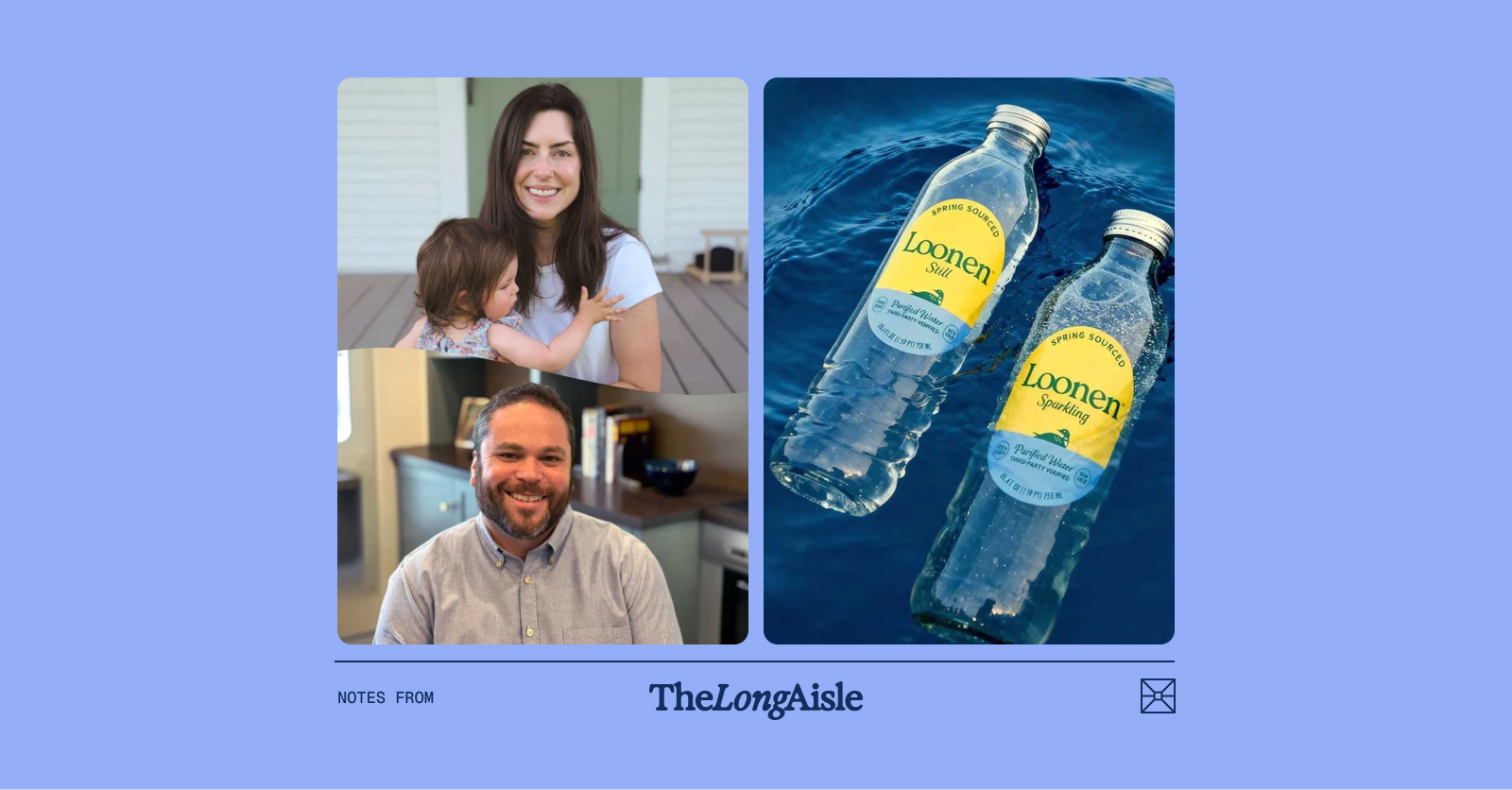
Clara Sieg & David Kimmell of Loonen: Notes from the Long Aisle
This post originally appeared in my weekly newsletter, BL&T (Borrowed, Learned, & Thought). Subscribe
Borrowed
"[It] can be so unexpectedly calming to take actions you'd been fearing or delaying—to finally hand in your notice at work, become a parent, address a festering family issue, or close on a house purchase. When you can no longer turn back, anxiety falls away, because now there's only one direction to travel: forward into the consequences of your choice."
From "Four Thousand Weeks" by Oliver Burkeman [Book]
Learned
This was my first interview with co-founders, and I’d been looking forward to it. In preparation, I’d listened to several podcasts with Clara Sieg. During IVF and early motherhood, she got serious about clearing endocrine disruptors from her life. She managed it in nearly every category but water, which led to Loonen. I was inspired by both the brand’s mission and the conviction it took to start it.
Clara built her career as a venture investor, talking to founders and sizing up their vision. Now, she’s the one betting on her own. She didn’t do it alone, though. Clara brought in an industry friend, David Kimmell, to lend his expertise. Having spent nearly a decade on the founding team at Spindrift, one might say David knows beverage.
Loonen is a bottled water brand built on the idea that you should know exactly what’s in your water and trust it completely. It’s water from a spring that never touches plastic. It gets tested by an outside lab for more than 350 contaminants, with the results accessible via QR code right on the bottle. Since launching late last year, it’s become the bottle celebrities and influencers can’t seem to stop posting.
All to say, it was a treat getting to “sit down” with Clara and David, exploring their history together, what it’s looked like to partner, and the early decisions they’ve made to make their partnership work. We also get into topics that hit home for me: work and life, parenthood and entrepreneurship.
Here’s what I took from this one.
Know what you don’t know, then find who does.
I asked Clara why David, of all the operators she could have built with. Her answer went straight to the lesson she took from years of investing: the founders who get in trouble are the ones who pretend to know things they don’t.
“The biggest lesson I took away from investing was knowing what you don’t know, embracing that, and then filling in the gaps with people who do know it, as opposed to trying to learn it yourself and act as if you know it. Because that’s the fastest path to making mistakes that are not recoverable from.”
I’ve been living this lesson for many years throughout my leadership journey, but it’s been the most real for me since moving into the CEO role. Rather than attempting to fill gaps on my own, stretching myself thin, I’ve recognized the power of bringing in folks who have been there and done that. Early on, I thought leading meant having the answers. It mostly means being honest about which ones I don’t have, and finding the person they belong to. These days, my job is less about the answers and more about holding the vision and giving the right people room to run.
Do the uncomfortable work before you commit, not after.
One of my favorite stories from our conversation is what happened before Clara and David signed anything. Clara built a long list of questions and spent two days going through it in person. They’d known each other for a long time, but building together is a different thing entirely. They explored how each of them approaches problems, thinks about culture, and defines success. Clara described it like this:
“We had a really painful two days of marching through it together, holding ourselves accountable and being really honest about it. It’s sort of like couples therapy. When you do it together, there’s a certain level of accountability.”
She reasoned that some things become intractable the moment you sign: equity, incorporation, and so on. So you have the hard conversation with much less at stake. It made me think about our own co-founders, Peter and Sei-Wook, college friends turned business partners who have worked together for 20 years. I’m pretty sure they never had a meeting quite like this, but they’ve always found their own version of it, bringing in consultants and coaches to keep them honest.
One that stands out for me was during the pandemic, when we brought on an executive coaching firm. Those sessions led to some of the most honest conversations I’ve been part of as a leadership team, and pushed me to be more open as a leader myself. At the time I was leading the creative team, and I started bringing that same energy to the full agency team. I’m a big believer in how much stronger relationships get when you understand your team, or your partner, that much better.
I deeply admire how Clara and David started. Whether in personal or business relationships, it’s often the little things you gloss over early on that become big things later.
Becoming a parent can make you a better builder.
For anyone weighing whether it’s the right time to start a business or have a child, I hope they find inspiration in Clara’s reframe. Clara had her daughter, Fiona, right as she and David started building, two of the most destabilizing things a person can do, at once. They joked that they’ve finally stopped measuring the company’s age against Fiona’s. When I asked what that journey has actually looked like, she called her daughter an accelerant.
“Motherhood for me has enabled me to embrace risk in a way that I haven’t historically. People just think of it as extra hours and more work on your plate. But I actually think being a parent is a superpower in terms of building a company.”
Her point was that keeping a human alive resets what feels risky, and that your hours get so precious you stop wasting them. I often reflect on how I’m more effective now, with two kids, than I’ve ever been. I catch myself wondering what my twenty-something self’s life would look like if I could hand him what I know now.
David has taken a version of this leap before. Early in his career, with a young family at home, he faced a fork in the road: a stable job at General Mills, or follow a friend into a basement to start what would become Spindrift. His wife told him he’d be miserable playing it safe. He took the basement. He jokes that the more people tell him he’s crazy, the more he figures he’s onto something.
I haven’t gone and started a company. But there’s rarely a perfect time for the big things, the business or the baby, and Clara’s perspective shows that maybe you don’t have to choose which hard one to do first.
Create and protect untouchable hours.
Clara and David don’t chase work-life balance. They don’t think it’s a goal you can hit. Instead, they protect a few windows they won’t move. Clara’s mornings with her daughter. David’s drop-offs, pickups, and basketball games. Everything else works around those.
“Not focusing on work-life balance, because it’s not possible and it’s not an achievable goal, but focusing on work-life integration so that those moments that are really precious are protected.”
I’ve learned this one over the years, though it’s not always easy to uphold. Some stretches pull harder at work, some pull harder at home, and the priorities move with them. And there’s so much to learn by dropping the barriers; who I am at work and who I am at home feed one another and make me better, all around.
Like Clara, I lean on a morning routine to ground me. I’m up before the house, and I journal before I check my phone or let the world in. Quiet time to think, read, exercise. It sets the tone for everything after. When there’s something urgent at work, though, protecting this time is difficult. Same goes for after the day ends, the time meant for my kids. I found it powerful how Clara frames this time in her life:
“When you’re with your kid and you don’t have your phone, nothing enables you to disconnect and sort of recenter in the same way.”
The hours with her daughter are also the ones that help her put herself back together. In that way, it’s less something she protects from work, and more the thing that makes the rest of it work.
Decide from where you want to be, not from where you are.
David described how he makes big calls. He starts at the destination, three years out, and works backward to now. He calls it “out to in,” and that’s why they say yes to painful decisions that don’t make short-term sense, like partnering with a major New York distributor while still shipping from a single West Coast facility.
“It’s really easy, if you’re just making decisions in the moment along the way, to make the wrong decisions. But if you say, where do we want to be in three years, and then work out to in, that provides a little bit of normalcy to some of the crazy.”
I appreciate David’s perspective here across so much of life and work. I’m a big believer in playing the long game, but what he points out is more pointed: sometimes a near-term decision only makes sense with the long-term in mind. On its own, it can look like a mistake. Held against where you’re trying to go, it’s obvious.
Early in my career, I thought good leadership meant planning well enough to stay ahead of everything. I’ve since learned that no plan is bulletproof. Clients change course, people move on, mistakes happen. What’s held up is keeping a clear enough picture of where we’re headed that the noise doesn’t knock me off it. That’s the normalcy David is talking about. It’s true at work and at home. The destination doesn’t make the crazy go away, but it gives you something steady to make decisions from.
Let the best argument win, even when it’s not yours.
We talked about how Clara and David handle disagreements, whether between them or with the team. David shared a short anecdote that said everything about how they operate, from a call about a marketing decision.
“Clara and I went into the call both aligned on one perspective, and Sarah (marketing at Loonen) had a different perspective, and Sarah’s articulation won. We got off that call, all three of us aligned with Sarah’s point of view. And that was the right one.”
What I like about this is that it isn’t about who was loudest or most senior. In Clara’s words, if you can articulate the reasoning and it makes good sense, they’ll do it. The bar is that you’ve thought it through and can make the case.
You see the same thing in how Clara tells the story of Expo West. She was against going, called it a huge amount of money for nothing. But the team made the case, so they went. By the end, she laughed, telling me how much she enjoyed it and that they’d have to carry her out. That trade show is where their Sprouts relationship started, their first national account.
To me, this is what it looks like to build a team with real conviction. Not just hiring good people, but creating a space where they feel they can speak up, as long as they can back it up. That kind of culture is hard to build in later. It’s cool to see Clara and David leading this way from the start.
More than a product.
When it comes to what they’re building, Clara and David look beyond the bottle of water and more to what it represents. David went right to his kids.
“I have a fourteen-year-old and a twelve-year-old. [...] they're really connected with what we're building with Loonen. I think it's just inspiring. They see how hard we're working to build this business, but still making time for family. Instilling those values to them in a way that words never could. With my son going to high school in the fall, if we can continue on this path and be successful, what that could shape for them is amazing.”
He also put their ambition alongside brands like Levi’s, Patagonia, and Clif Bar. “Really building generation-defining brands,” he said, “more than being a product.” For Clara, it came back to the category itself.
“Now that we know better, I think we can do better. My hope is that we can help move the category forward, invite other brands to do the same, and be a trusted part of the consumer's day to day.”
Neither of them mentioned an exit or a number.
This is where the whole conversation comes back around for me. Clara opened by talking about her own mom, who changed how the family ate while going through cancer treatment, long before any of it was common. She didn’t teach Clara those values with a lecture. She lived them, and they stuck with her for good. Now Clara is doing her own version of that in front of her daughter. The company is the work, and there’s a positive impact it will make in this industry, but in that are the values in how they build it that their kids will carry with them.
I never know how these conversations will take shape. I appreciated how open Clara and David were, and how much they shared about their experience as parents. As someone right in the middle of it myself, I walked away from this one with a lot of fuel for the work and everything around it.
+
Listen to the full episode with Clara and David:
If it resonates, a rating, review, or share goes a long way this early on.
+
More here: https://www.thelongaisle.com/episode/loonen-clara-sieg-david-kimmell
Thought
What am I treating as a constraint that's actually fuel?
Am I deciding from where I want to be, or just from where I am?